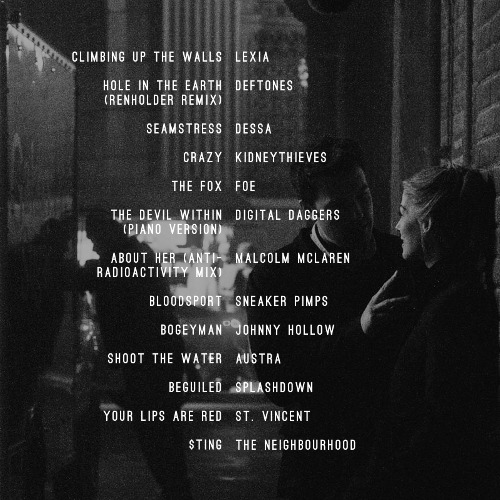
OPEN UP YOUR SKULL; an amy dunne mix
“amazing amy is gone” // tracklist
Author: seareigns
I take back what you have stolen,
and in your languages I announce
I am now nameless.
My true name is a growl.
Margaret Atwood, from “The Animals Reject Their Names and Things Return to Their Origins” (via elucipher)
Then I saw it. I saw a mom who would die for her son. A man who would kill for his wife. A boy, angry and alone. Laid out in front of him, the bad path. I saw it. And the path was a circle. Round and round. So I changed it.
Polypheme and Odyssea, my combatants for Jenn Woodall’s FIGHTZINE, featuring an all-female cast of fighting game characters. These ended up being closer to Dark Souls enemies (maybe my Ornstein and Smough), but hey.
I picture these two as invulnerable from the front and weak to the rear, with Polypheme’s shield and spear, and Odyssea’s gun keeping the player at bay. I imagine you’d get a few seconds to wail on their weaker side before being skewered on Polypheme’s flaming trident and hurled across the screen.
I knew I wanted to do a pair from the beginning, but I couldn’t really figure things out. I tried out some stuff with a tandem bow, one holding and aiming, the other drawing back the arrow, but visually it didn’t work. Things didn’t really develop until I drew Polypheme’s giant shield, and even then, it wasn’t until the shield became a face with a mouth that the pair clicks. The shield became a cyclops later, after looking at some Indian puppet masks, I think. She became Polypheme, and the other became Odyssea. The trident was a sword originally, but, Polyphemus, being the son of Poseidon, already has a link to the trident. The flaming part of the trident is a small nod to the flaming wooden stake Odysseus uses to blind the cyclops.
I have a big reference folder full of matchlock guns from different time periods, culled from a few trips down the ol’ Google images rabbit hole, so that popped up. It seems mindlessly scanning Google images or Tumblr or whatever would just be a timesink and nothing else, but you never know. It pays off to keep track of the things you find visually stimulating, just in case.
These are two disparate examples of how I design characters — sometimes a lot of narrative choices go into the character, like in Polypheme, and sometimes it’s just a collection of interesting shapes, patterns, etc, like with Odyssea. The first is active, where I’m trying to fulfill some mental picture, the second is reactive, where I’m building the narrative after the shapes come together. They both have their merits.
I’m happy to add this piece of tonal dissonance to what is otherwise shaping up to be a very fun zine.
ethereal
hey did you know at i am pure and stellar and otherworldlyWhen did you take this and why wasn’t I informed?
All I want is education, and I am afraid of no one.
Malala Yousafzai
on Wednesday we wear black
In many ways, the work of a critic is easy. We risk
very little yet enjoy a position over those who
offer up their work and their selves to our judgment.

We thrive on negative criticism, which is fun to write
and to read. But the bitter truth we critics must face
is that, in the grand scheme of things, the average
piece of junk is more meaningful than our criticism
designating it so.

But there are times when a critic truly risks something,
 and that is in the discovery and defense of the new.
Last night, I experienced something new, an
extraordinary meal from a singularly
unexpected source.

To say that both the meal and its maker have
challenged my preconceptions is a gross
understatement. They have rocked me to
my core. In the past, I have made no secret
of my disdain for Chef Gusteau’s famous motto:
Anyone can cook.

But I realize that only now do I truly understand
what he meant. Not everyone can become
a great artist, but a great artist
can come from anywhere.

It is difficult to imagine more humble origins than
those of the genius now cooking at Gusteau’s,
who is, in this critic’s opinion, nothing less than
the finest chef in France. I will be returning
to Gusteau’s soon, hungry for more
— Anton Ego
Anthony Bourdain. Source : buzzfeed.com
princeoberryn-deactivated201606:
Pedro Pascal photographed by Anthony Batista.
 SEAREIGNS